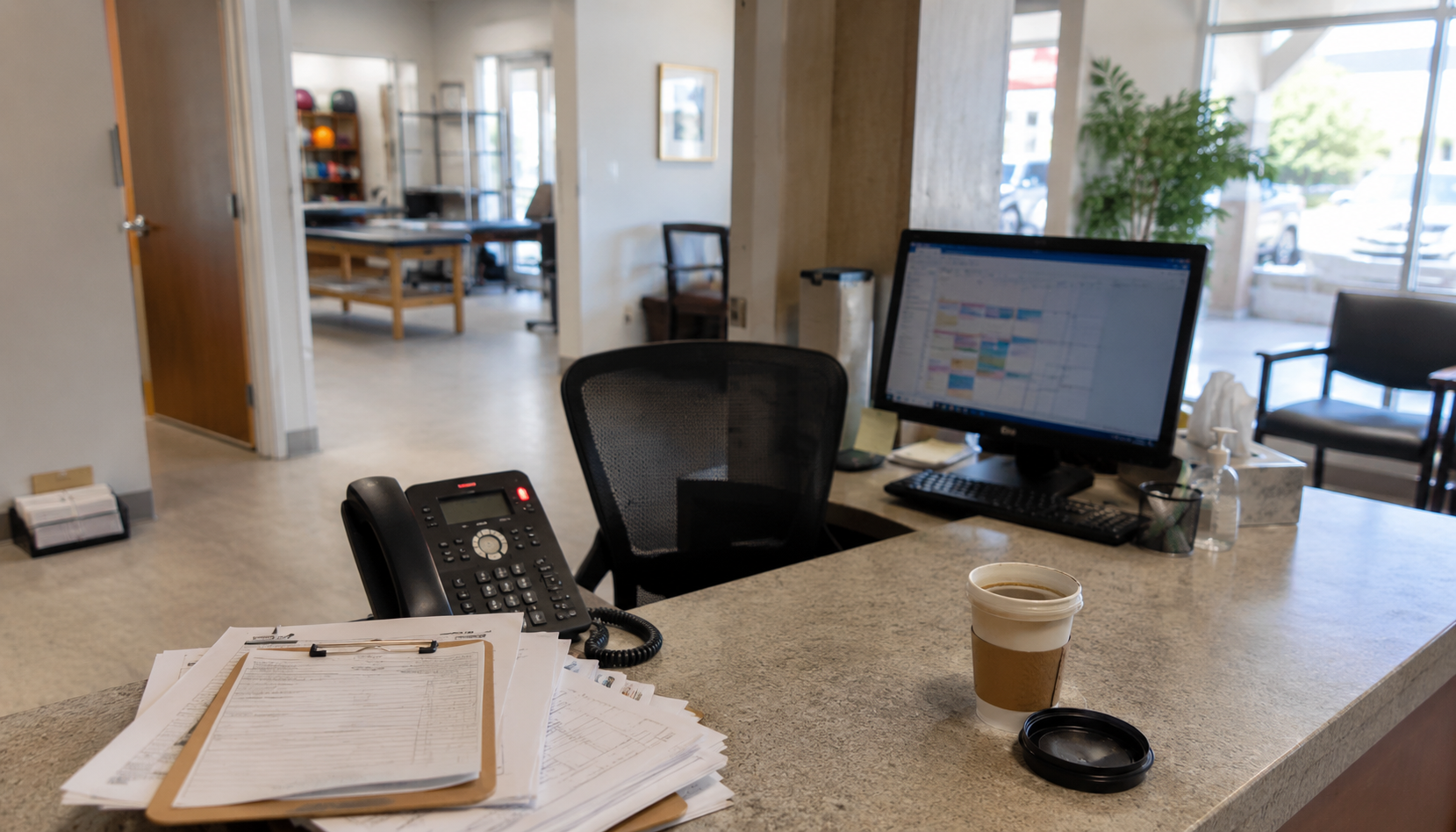
A clinic owner feels the schedule soften and usually starts looking outside the building.
A few more physician drop-offs. A stronger Google ad. A social post that finally gets shared. A lunch with a referral office that used to send more patients. The owner isn’t being foolish. When visits are down, it feels reasonable to go find more people.
But before you spend another dollar, listen to what happens when the phone rings. Your front desk may already be telling you whether you have a marketing problem, an operations problem, or a standard you haven’t clearly defined.
A front-desk issue doesn’t always look dramatic. It can look like a call that goes to voicemail during lunch. It can look like a new patient who gets a polite answer but no urgency. Or a lead who fills out a form on Saturday and hears back Monday afternoon. Or a front desk that doesn’t know what one new evaluation is worth to the clinic.
The owner sees empty slots and thinks, “We need more leads.” Sometimes that’s true. A lot of the time, the clinic isn’t doing a good job with the leads it already has. So before you decide you need more marketing, define what should happen at the front door and check whether it’s happening.
More Leads Expose the Front Door You Already Have
More marketing gives the clinic more chances to do whatever it already does with a call.
If the phone gets answered well, the call gets tracked, the patient gets scheduled, and the team follows up when a slot opens, more marketing can help. If those pieces are loose, more marketing gives the clinic more ways to waste the same opportunity.
I worked with an owner who had two clinics in neighboring towns. One clinic had strong reviews, steady conversion, and a front-desk team he trusted. The slower clinic needed more volume, so he was buying physician-office lunches and trying to create referral momentum. The lunch plan felt like marketing. The deeper question was whether the clinic could convert the inquiries it already had.
That owner eventually shifted the conversation. He stopped buying lunch trays for whole physician offices and started asking individual physicians for an hour of direct conversation. Then he looked at the internal handoff. Who was responsible for leads generated? Who was responsible for leads converted? Who met weekly to look at both numbers?
That’s the sequence most owners want to skip. They want the campaign first and the front-door discipline later. But if the front desk doesn’t have a clear standard for answering the call, following up, and filling the open slot when the schedule changes, the campaign just sends more calls into the same loose process, and the owner still won’t know whether marketing was the problem in the first place.
The owner’s job is to know the path from inquiry to scheduled evaluation. A person calls. Someone answers or they don’t. The person on the phone understands the patient’s problem or they don’t. The patient gets scheduled, placed on a waitlist, or lost. If they don’t book, there’s someone whose job it is to follow up, or the lead drifts. If a cancellation opens a slot, someone knows who to call first or the space stays open. That whole path is a service standard, and it tells the team what good looks like before the owner gets frustrated that the number didn’t move.
The Physical Therapy Front Desk Controls More Than the Schedule
The front desk controls the number. It doesn’t control the whole business or clinical quality, but the number of patients who make it from interest to a visit depends heavily on the person who answers, schedules, follows up, and sees the schedule before anyone else does.
Many clinic owners bonus therapists for productivity and barely involve the person who determines whether those therapists have patients in front of them. That doesn’t mean every clinic needs a complicated bonus plan. It means the owner needs to stop treating the front desk as a passive scheduling function. The front desk is part of patient acquisition, and the person in that seat needs to know that.
If a new evaluation is worth meaningful revenue over the full plan of care, the person answering the phone should know that in plain language. Not as pressure. As context. “When we get this call handled well, it can become several weeks of care for a patient who needs help, and it can fill a clinician’s schedule in a way that supports the whole clinic.” Staff can’t care about numbers the owner hasn’t explained to them.
The same owner who wants better conversion often hasn’t defined the behavior. Does every call get answered live during business hours? If not, what counts as an acceptable callback window? What happens after hours? Who checks web forms on Saturday morning? What does the front desk say when the first available appointment is two weeks out? How many times does the team follow up before they stop? What gets documented so the owner can see what happened?
Those questions sound simple until you ask them. Then you find out the clinic has been running on individual judgment.
One person is warm but doesn’t create urgency. Another person is efficient but sounds rushed. One person follows up twice. Another assumes that if the patient wanted it badly enough, they’d call back. One person knows which providers have openings. Another waits for the owner to tell her who to move. None of that means the staff is lazy. It means the standard is missing or uneven, and if the front desk doesn’t know what good looks like, the owner hasn’t finished the job.
Do Not Build the Standard Around One Bad Week
There’s another trap here. Once an owner starts paying attention to the front door, one bad week can make everything feel broken.
An owner I worked with hit a rough stretch after a holiday week. Evaluations were higher than usual, the phones kept ringing, and cancellations piled up on one ugly Friday. The front desk was overwhelmed. By the time we talked, she was ready to redesign the intake process and build a permanent fix so that kind of week couldn’t happen again.
We slowed it down. If she built permanent structure around that one Friday, the team would end up living under rules created by the clinic’s worst moment of the quarter.
So she pulled the numbers and separated the trend from the noise. Lead volume was up enough to plan around. The cancellation spike wasn’t. The front desk didn’t need a speech about staying calm. They needed to see what was recurring and what was simply hard.
That’s the kind of judgment you have to bring to the front desk. You don’t ignore a problem because it may be temporary. You also don’t create a new policy every time the clinic has a brutal Friday.
Look for patterns. How many calls are missed by day and time? How long does it take to return them? How many web inquiries become scheduled evaluations? How many people say they need to check their calendar and don’t hear from the clinic again? How often does an open slot get filled from the waitlist? How often does the team miss the open slot until it’s too late to fill it?
Those numbers don’t have to be fancy. A simple tally for a few weeks can tell the owner more than a new marketing campaign. The goal is to learn whether the clinic has a repeatable problem or a painful outlier. The trend gets a plan. The blip gets a “that was a rough one, it’ll settle, and here’s why.”
Once the owner knows the pattern, the response gets easier. A lunch-hour call gap may mean staggered breaks. Slow web-form response may mean someone checks web forms at set times, including after hours. Weak follow-up may mean a simple rule: every unbooked new-patient inquiry gets two follow-up attempts, documented in the same place, before the clinic lets it go.
That’s operations. It isn’t glamorous, but it’s usually cheaper than buying more leads and hoping the same front door handles them differently.
A Service Standard Beats Policing Every Call
The owner can’t sit beside the front desk all day correcting tone, urgency, and follow-up. That creates a different problem. The front desk starts trying to satisfy the owner’s preferences instead of using a standard the whole team understands.
I worked with an owner who wanted a high standard for written communication. Texts, emails, inbox replies, all the places where tone can get missed. She was a perfectionist and knew the danger. If she corrected every message based on her own taste, the team would feel nitpicked and she would become the bottleneck.
The standard I gave her was the same one I used with my own employees: talk to people like you’d talk to my mom. Warm even when the answer is no. Helpful even when the clinic can’t do what the person wants. If something could land harsh in writing, pick up the phone.
That kind of standard works because people can remember it when the owner isn’t in the room. But it still needs examples. Show the team a cold-but-accurate reply and a warmer reply that says the same thing. Show them how to tell a patient, “We don’t have that appointment time, but here’s what we can do.” Show them how to explain a wait without making the patient feel like an inconvenience.
A front-door standard should be that concrete. It should include tone, speed, follow-up, scheduling options, and documentation. It should tell the person answering the phone what to do when the easy answer is unavailable.
For example:
- If a new patient calls during business hours, we answer live whenever possible.
- If we miss the call, we return it within the time we’ve agreed on.
- If the first requested time isn’t open, we offer the next best option and tell them how we’ll watch for an earlier opening.
- If the patient doesn’t book, we follow up using the steps we’ve agreed on.
- If an open slot appears, the front desk knows whose job the callback is.
- If a message could sound cold in writing, we call.
A list like that can feel like micromanagement when you write it down. It’s the opposite. It’s the standard that lets you stop correcting every call. The team can’t hold a standard that only exists in your head.
Measure the Door Before You Blame the Market
An owner of a cash-pay pediatric practice once thought parents were dropping out because of price. Parents called, said they were interested, received paperwork, and then disappeared. The owner adjusted payment options and session length, but the conversion problem started earlier.
The first commitment the parent had to make was completing the paperwork and showing up, well before the evaluation. So the work moved to the first phone call. The person taking the call needed better questions. What’s going on? How long has it been happening? What’s this stopping your child from doing? What have you tried already? The call had to help the parent say, out loud, why the appointment was worth completing.
Then the clinic measured the conversion from inquiry to completed paperwork to attended evaluation. The owner stopped guessing where the patient disappeared.
That same logic applies to insurance-based PT, OT, and SLP clinics. If the schedule is soft, don’t start by declaring that referrals are down, the market is harder, or Google has changed. Start with the door.
How many inquiries were lost because the first available appointment was too far out? How many past patients were contacted before the owner paid to reach strangers?
When visit volume dips, a new campaign is rarely the first thing to do. Past patients who discharged happy and haven’t needed to come back are often the cheapest, highest-trust group to reach. A check-in call or reactivation note costs almost nothing compared with a new referral campaign. But even that depends on the front door. If the patient replies and the clinic doesn’t follow up well, it wastes the easiest opportunity it has.
This is the owner’s decision point. If the front desk is handling the calls it already gets, marketing can be a good next step. If it isn’t, marketing should wait while the owner fixes the standard, the phone coverage during lunch and after hours, the tracking, and the follow-up.
Before you spend more, check this:
- Do we know how many new-patient calls and web inquiries came in over the last few weeks?
- Do we know how many reached a person quickly?
- Do we know how many scheduled an evaluation?
- Do we know why the others didn’t schedule?
- Does the front desk know what one new patient is worth to the patient, the clinician, and the clinic?
- Does the team have a written follow-up standard for unbooked inquiries and open slots?
- Have we contacted past patients before spending money to reach people who haven’t heard of the clinic?
- If the schedule is still soft after that, are we adding marketing on top of a front desk that already works?
You don’t have to answer all of that perfectly today. But if you can’t answer most of it, you don’t yet know whether you have a marketing problem or a front-door problem.
Spend money after you know what happens when the phone rings.
If you’re not sure whether you have a marketing problem or a front-door problem, that’s the kind of thing I help owners sort out. Let’s talk.