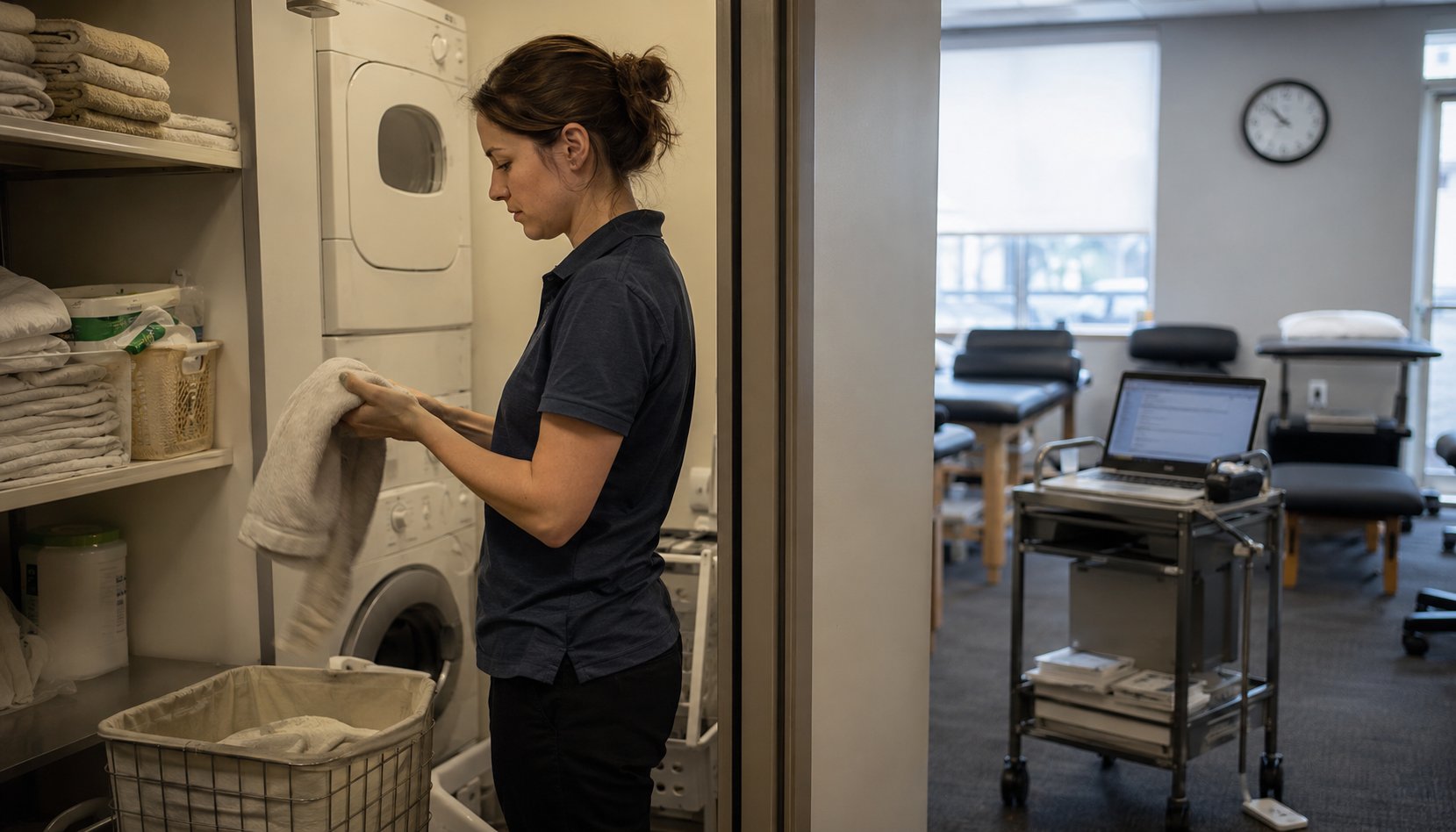
A therapist finishes a double-booked afternoon, wipes down the tables, folds a load of laundry, takes out the bathroom trash, checks the voicemail because the front desk got buried, and then gets asked if she can help plan the staff birthday lunch. That slow pile-up has a name: role creep.
None of those tasks sounds outrageous by itself.
Every small clinic has days when everyone pitches in. Someone spills coffee in the waiting room. A tech calls out. The front-desk staff get slammed. The owner jumps in. The PT grabs a towel. The SLP helps a parent find the right form. That is normal clinic life.
But role creep is a different pattern, and owners need to name it when they see it. It is the pattern where non-clinical work keeps getting added to licensed clinicians because the clinic has not designed the support around them. Bathrooms. Laundry. Front-desk coverage. Insurance calls. Birthday planning. Lunch meetings that eat the only break in the day. Emotional labor because someone is the young and fun one on the team.
The owner may experience that as being scrappy. The clinician experiences it as a double-booked afternoon that still ends with laundry, and notes that get written at home that night.
The problem is not that a therapist helps occasionally with a non-clinical task. The problem is when role creep becomes the staffing model.
When that happens, the clinic teaches the team a lesson the owner never meant to teach: the license is valuable when it generates revenue, but cheap enough to spend on whatever task no one else owns.
The staff sees what the owner values by what the owner is willing to protect.
Frugal and Expensive Are Not Opposites
I understand the pressure behind this.
Small clinics do not have endless admin layers. A small PT, OT, or SLP practice is often one call-out away from chaos. The owner is watching payroll, reimbursement, cancellations, AR, benefit costs, software fees, rent, supplies, and the next hire they are not sure they can afford. Hiring another admin person or a cleaner can feel irresponsible when the month-end numbers already look tight.
So the owner does the natural thing. They spread the work around.
A little laundry here. A little front-desk help there. Everyone takes a bathroom day. Therapists help with phones when the front desk is behind. A salaried clinician stays late for a task that never made it onto the schedule. The owner tells themselves, “We all have to help.”
That sentence is true in a crisis. It becomes dangerous as a default.
An owner can save cash and spend something more expensive. They can spend clinician focus. They can spend morale. They can spend the goodwill that makes a strong therapist stay through a rough season. They can spend the trust that lets the team believe the owner understands what the day actually feels like.
If the highest-paid clinical hour in the building is being used for work that does not require a license, the owner has to count more than the wage. The visible cost is the hourly rate. The less visible cost is what does not happen while that hour is being used somewhere else.
The therapist writes the eval note later. The plan of care gets written after dinner. The therapist walks into the next visit carrying the last task in their head. The owner never redesigns the front desk because the team keeps absorbing the overflow. The owner never sees the true admin burden because it is scattered across clinicians who are trying not to complain.
The clinic may be reducing one line item while increasing turnover risk, patient-experience risk, and owner-dependence. That is not frugal. That is expensive in a way the month-end report may not show until the damage is already underway.
Not all savings are good savings. Some savings cost more than they protect.
The Task Is Not the Real Issue. The Role Design Is.
When a clinician says, “I shouldn’t have to clean bathrooms,” the owner can hear entitlement if they are already stressed.
That is the wrong read.
The better question is: what job did we hire this person to do, and what job are they actually doing on a Thursday afternoon?
A clinic kept losing front-desk hires. The owner’s first read was that the candidates lacked commitment. The newest hire had not completed onboarding, had not worked through the systems, and was already giving notice. It looked like another weak hire.
Then we listed the role.
Phones. Check-in. Faxing progress notes. Insurance verification. Copays. Coinsurance. Cancellations. Rescheduling. EMR notifications. Billing handoffs. Learning the whole software system. That was not one front-desk job. It was several jobs stacked into one seat and paid like an entry-level role.
Once the owner saw the stack, the conclusion changed. The hire had not failed inside a well-built role. The clinic had asked one person to hold a pile of work that no one had designed.
The fix was not another motivational talk. The owner pulled the work apart. Billing moved out of the front-desk role. The new front-desk scope became phones, check-ins, and a smaller set of repeatable tasks. Billing got treated as its own function, not something to squeeze between patient arrivals.
That same audit applies to clinicians.
A PT can help with patient flow. A COTA can support team rhythms. An SLP can contribute to culture. But if the owner keeps adding cleaning, front desk, staff social coordination, unpaid meetings, supply chasing, schedule filling, and whatever else no one owns to a licensed provider’s week, the owner has not built a team. They have hired helpers and kept the operating mess distributed across them.
If every problem comes back to the owner, the owner has hired helpers, not built a team. Role creep is one way that shows up. The owner does not have a system for the work, so the work gets handed to whoever is closest, most agreeable, or least likely to push back.
Most accountability problems start as clarity problems. Before an owner asks whether the team has the right attitude, the owner should ask whether the clinic has named the job clearly enough to hold anyone accountable.
A vague role turns every helpful person into the backup plan.
The Strongest Team Members Usually Pay First
Role creep rarely spreads evenly.
The staff member who says yes gets more. The therapist who is organized gets the extra admin task. The young clinician who wants to be liked gets the birthdays, the catering, and the bonding activities. The reliable provider gets pulled to the front desk because she can handle it. The person who already charts late gets asked for one more thing because she has not made a scene.
That pattern feels practical in the moment. It is dangerous over time.
The owner is rewarding reliability with burden. The clinic is teaching the strongest people that competence means getting less protection, not more trust or more opportunity. Eventually the owner is surprised when the reliable one becomes short, guarded, or starts looking for a side hustle.
That is not a character mystery. That is a predictable response to a role that keeps expanding without a new agreement.
A clinic owner once wanted to hire a VA because the front desk needed help and the building did not have room for another in-person admin hire. The obvious choice was to give the VA to the owner. The better choice was to make the front-desk lead the VA’s direct manager.
That did two things.
First, it gave the front-desk lead real leadership responsibility instead of more random work. Second, it forced the clinic to write down the SOPs that had been living in her head for years. The owner handled the orientation. The front-desk lead trained the VA on daily workflow. The owner coached the front-desk lead on how to delegate, give feedback, and manage someone else.
That is the difference between dumping work and designing growth.
Dumping work sounds like, “Can you also handle this?” Designing growth sounds like, “This is the role, here is the authority, here is the standard, here is how I will support you while you learn to lead it.”
If a therapist is going to own a non-clinical function, name it. Is it leadership development? Is it a temporary coverage plan? Is it a paid admin block? Is it part of a clinical director track? Is there time on the schedule for it? Who stops asking them for it when the work is done?
If the answer is not clear, the owner has not delegated well. They just added work.
Delegation without scope, time, training, and authority is just role creep with better language.
A team will not take ownership in a business where ownership means absorbing whatever the clinic failed to design. They will protect themselves instead. And they should.
A License Should Change the Math
A licensed therapist’s hour is not interchangeable with every other hour in the clinic.
That does not make the therapist above basic teamwork. It does mean the owner has to treat licensed time as a scarce resource. If a PT, OT, SLP, PTA, COTA, SLPA, or Clinical Fellow is doing work that a cleaner, tech, admin hire, VA, better checklist, or better schedule block could handle, the owner needs a reason beyond “someone had to do it.”
Sometimes the reason is real. A small clinic has a true one-off problem. A snow day wrecked the schedule. The cleaner missed. The front desk person got sick. The owner and team make the day work.
The test is whether the task has become normal.
If clinicians are cleaning bathrooms every week, that is not teamwork. That is a facilities plan.
If clinicians are covering phones every lunch, that is not pitching in. That is front-desk capacity.
If clinicians are doing insurance calls because the admin system cannot keep up, that is not a helpful attitude. That is a revenue-cycle design issue.
If a salaried provider is staying late for meetings, cleaning, birthday planning, and documentation, the owner should look hard at what the clinic is asking that person to donate.
The fix starts with a task audit, not a speech about culture.
Write every recurring non-clinical task on paper. Cleaning. Laundry. Phones. Voicemail. Schedule changes. Benefit checks. Authorizations. Supplies. Team events. Social media. Meetings. Note whose time is currently being used. Then ask four questions:
- Does this task require a license?
- Does this task protect patient care, revenue, compliance, or team function?
- Who should own it on a normal week?
- What standard tells us it was done well?
Many clinics get stuck on that fourth question because the standard was never named.
An owner I worked with was drowning in tasks. A staff member had given notice, a new clinician was about to start, a new service line needed to be built, and another location was on the table. His first instinct was to push the next pile of work toward the clinic director because she was the senior person. She was already managing marketing visits, front-desk issues, tech supervision, and onboarding.
Another owner in the conversation had already been through that trap. He stopped asking, “Who can I push this to?” and brought the task list to the team instead. Who wants to own any of this? A therapist wanted the new service-line build. Another staff member was interested in recruiting. Someone who had recently been onboarded was the best person to help write the new-hire process because she still remembered what had been confusing.
The work did not move because the owner gave a motivational speech. It moved because each task got a visible card, a deadline, steps, and a definition of done. Before anyone accepted the work, the owner asked whether the task was clear. If it was not clear, they had a short meeting before the deadline was set.
The same thing applies here. “Everyone helps” is not a standard. “The treatment rooms are reset after each visit by the person who used the room” can be a standard. “Bathrooms are handled by the cleaner on a set schedule” can be a standard. “A mess during clinic hours goes to the front desk, not to whichever clinician notices it first” can be a standard. “Clinicians do not cover phones except during a named emergency protocol” can be a standard.
If the team does not know what good looks like, that is the owner’s job to fix.
The question is not whether people are willing to help. The question is whether the clinic has confused help with a staffing plan.
The Role Creep Audit to Run This Week
This is not about protecting clinicians from ever doing something outside their job description. Small clinics need flexibility. Good teams help each other.
The owner’s job is to make sure flexibility does not become the way they avoid underbuilt roles, missing admin capacity, or delayed decisions.
Use this audit before the next staff meeting:
- List every non-clinical task a licensed provider did last week.
- Mark which tasks were one-time emergencies and which ones repeat.
- For each repeating task, name the real owner: cleaner, front desk, tech, VA, office manager, clinician, or owner.
- If a clinician owns it, write the reason, the time block, the pay treatment, and the standard.
- Identify one task currently using licensed time that should move somewhere else if needed.
- Write the first version of the handoff, even if it is ugly.
- Tell the team what will change and what will not change, so they are not left guessing.
The clinic does not have to become corporate to protect role clarity. It just has to stop pretending that whatever lands on the most reliable person is a plan.
A therapist is not cheap labor for every unowned task in the building. Protecting that license is not pampering the team. It is how the owner protects clinical focus, patient care, margin, and the kind of culture strong people want to stay inside.
I’m a business coach for PT, OT, and SLP clinic owners. I work one-to-one with owners doing $1M to $5M in revenue and run monthly mastermind groups of four owners using a hot-seat format. If your strongest people keep absorbing whatever the clinic has not designed, and you want roles your team can actually trust, get in touch.