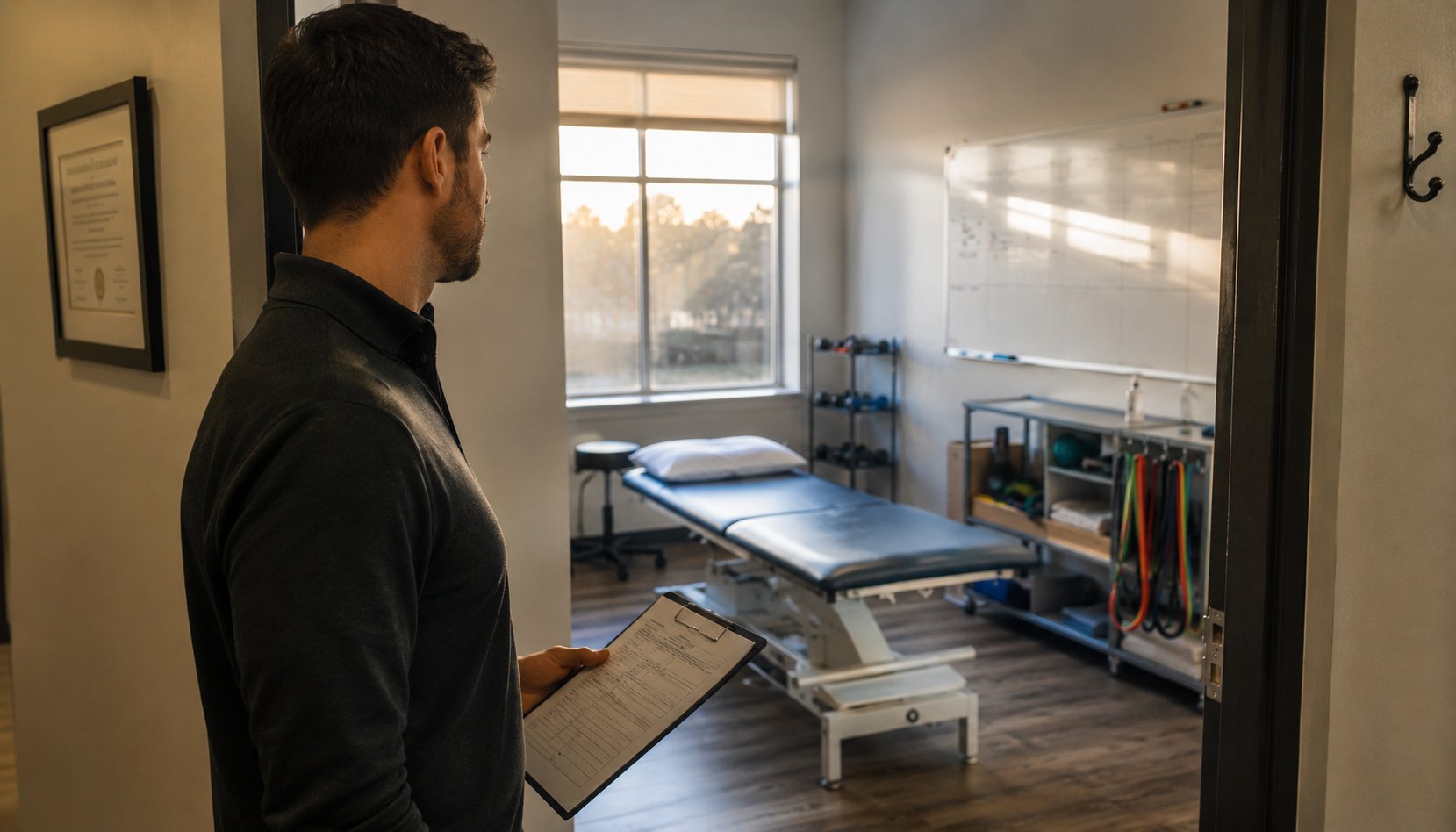
The owner did not sound careless. She sounded competent and tired.
Her orthopedic PT practice was busy. Patients asked for her by name. The front desk had learned to solve scheduling pressure by putting more people on her calendar. Some days that meant double-booking or triple-booking the owner because the demand was real and the team knew patients would say yes to her.
From the outside, the answer looked obvious: hire another PT.
Inside the business, the harder question was not whether there was enough work. There was. The harder question was whether the clinic knew how to move that work to someone else without making the owner the translator, fixer, quality-control department, referral source manager, mentor, and backup plan for every decision.
That is the conversation most owners are not having when they post the first PT job.
The schedule is packed. Notes are getting finished at night. Patients want the owner. The front desk is squeezing people into any open time they can find. A spouse has started asking how long this pace is supposed to last.
From the outside, the diagnosis looks simple: you need another PT.
Sometimes you do.
But the first PT hire is not only a capacity decision. It is the moment when the owner finds out whether care, decisions, standards, and patient trust can happen through someone other than the owner.
That is a different test.
Most owners treat the first hire like a courage test. Can I finally take the risk? Can I afford payroll? Can I trust someone else with my patients? Can I stop being the only clinician people want?
Those questions are real, but they are not enough. The first hire also tests whether the clinic has a repeatable way to run without every answer coming out of the owner’s head.
The offer letter is not where the test starts. The test starts before the job is posted.
The Owner Learns What the Clinic Can Actually Carry
A clinic can look ready for a first PT hire and still be fragile.
Full schedule. Strong word of mouth. Patients who love the owner. Enough demand to justify the payroll line. Maybe even a waitlist.
Those are good signs. They are not proof that the clinic is ready.
A clinic built around the owner can produce demand without producing a business. The owner’s hands, judgment, personality, and reputation can hold the whole thing together for a long time. Patients keep coming because they trust the owner. The front desk keeps asking because the owner knows the answer. Clinical decisions keep moving because the owner is nearby. Problems get solved because the owner is in the building.
That arrangement works until the owner tries to add another clinician.
One coaching client hit that point in an orthopedic PT practice. The clinic was busy, with a small clinical team and a full weekly visit schedule. From the outside, the growth looked strong. Inside the clinic, she was still the highest-producing clinician. Patients asked for her by name. Her front desk double-booked and sometimes triple-booked her because that was the easiest way to satisfy demand. When something went sideways, she was the person who fixed the problem.
The first honest look at her own schedule made the decision unavoidable. Her hands were the limit on the business. If she kept absorbing the demand personally, the clinic would stay where it was. If she wanted the clinic to grow, she had to create space for another PT to carry real work.
So she hired a new-grad PT and changed the rules around her own schedule. She protected regular time for deep work, SOPs, and business decisions. The front desk got a new standard: no more triple-booking the owner because a patient asked for her. Overflow went to the new therapist.
The surprising part was the patient transition. The patients who had been asking for the owner did not push back the way she expected. The front desk used a simple frame: the owner hired this therapist because he is good, and she would not have hired him otherwise. Most patients accepted it.
The harder part came after the hire started. One more clinician did not mean one more producer only. It meant one more person to onboard, coach, calibrate, and manage. The clinic had crossed a stage line. The owner had not only hired a PT. She had hired a leadership relationship.
That is the part owners often underestimate.
You see the same shift outside health care when a founder makes the first non-founder hire. The hard part is not only giving someone tasks. The hard part is teaching the judgment that used to be automatic because the founder was the one doing the work. A teacher feels a version of it too. Doing the math problem at the board is different from teaching another person how to solve it when you are not standing next to them.
A first PT hire creates that same shift inside a clinic. The owner is not just handing off visits. The owner is handing off judgment, language, patient confidence, documentation habits, and the clinic’s tolerance for ambiguity.
Before the owner posts the job, the owner has to answer a blunt question: are we ready for someone else to treat patients in a way that still feels like this clinic?
If the answer is no, the problem is not the candidate pool. The problem is that the owner has been carrying too much in their own head.
A strong first hire will not fix that by being strong. A strong first hire will ask good questions faster. They will notice unclear standards faster. Their questions, mistakes, and patient handoffs will make every unclear standard visible.
With a weak first hire, the owner sees the same problem in more painful ways.
The first PT hire needs to be treated as an operating-system question, not only a recruiting question.
Before the offer letter, the owner should be able to answer a few plain questions.
What does a good evaluation look like here?
How do we talk about plan of care expectations?
How do we document so claims can go out without sitting in someone’s note queue?
How does the front desk decide whether a patient goes on my schedule or the new PT’s schedule?
What kinds of clinical decisions can the new PT make alone, and which decisions come back to me?
What does the new PT do when a patient says, “I really wanted to see the owner”?
If the answers are all, “They’ll ask me,” the clinic is not ready in the way the owner thinks it is.
The schedule may be ready. The payroll math may be close. The clinic’s systems are still behind.
Breakeven Is the First Gate, Not the Whole Test
The money question has to come early.
A first PT hire creates a cash gap before it creates relief. Payroll starts right away. Credentialing takes time. The new PT’s schedule does not fill perfectly on day one. Documentation habits have to be built. Referrals have to be directed. The owner has to know how many visits the hire needs to carry, at what average revenue per visit, before the hire stops being a drain on the clinic.
Skipping that math is not optimism. It is gambling with payroll.
But breakeven is still only the first gate.
A clinic can know the breakeven number and still fail the hire because the owner has not decided how the work will actually move through the clinic.
The financial model answers one question: what has to happen for this hire to pay for itself?
The operating model answers the next question: how will the clinic make that happen without the owner chasing everything personally?
Those are not the same question.
The first PT hire needs a ramp plan. Not a vague hope that the schedule fills. A real ramp.
How many evaluation slots are expected early in the ramp, again after the first few weeks, and again once the hire should be carrying more of the schedule?
Who is responsible for steering appropriate patients to the new PT?
Which referral sources need to know the clinic has added capacity?
How will the owner watch visits, attendance, units where applicable, documentation completion, plan-of-care conversion, and patient retention without turning the new PT into a spreadsheet project?
What happens if the schedule is not filling fast enough?
What happens if the schedule fills faster than the new PT can handle?
One of the easiest mistakes is to treat a full owner schedule as proof of transferable demand. It is not always transferable. Sometimes patients are attached to the owner’s name. Sometimes the referral source trusts the owner personally. Sometimes the front desk has been trained, by habit, to solve every scheduling problem by using the owner’s time.
A new PT does not inherit that trust automatically.
The owner has to transfer it deliberately.
That starts with how the team talks. If the front desk says, “She’s booked, but we can put you with someone else,” the patient hears second choice. If the front desk says, “She brought this PT onto the team because this is exactly the kind of patient she trusts him with,” the patient hears confidence.
That one sentence will not save a bad hire. It will help a good hire get a fair chance.
The same is true with referral sources. If a physician’s office has referred to the owner for years, the new PT needs more than a name on a website. They need a real introduction. The owner may need to say, “When you send this kind of case, I want you to feel comfortable sending them to her. We are reviewing these cases together, and she is treating inside the same standards you’ve come to expect from us.”
Again, not a script as theater. A transfer of trust.
The owner also has to decide what numbers will be watched and what action each number calls for.
Monthly financials are too slow for this part of the hire. By the time the month-end report arrives, the new PT may already be a few weeks into habits that are hard to unwind. The owner does not need a complicated dashboard. The owner needs a weekly rhythm that shows whether the ramp is working.
Evals booked. Visits completed. Attendance. Notes completed on time. Claims ready to go out. Plan-of-care follow-through. Open slots. Patient feedback. Referral source feedback where relevant.
The point is not to bury the new PT in metrics. The point is to keep the owner from managing by mood.
If the owner only looks when the bank account feels tight, the owner will respond late and emotionally. If the owner looks every week, the owner can coach the pattern while it is still small.
When the owner reviews the ramp every week, the conversation can stay specific: what changed, what support is needed, and what the new PT owns next.
The New PT Learns From What the Owner Protects on the Calendar
Owners say a lot of true things during hiring.
We believe in mentorship.
We do one-on-one care.
We don’t want you burning out.
We care about documentation quality.
We want you to grow here.
The new PT learns more from the first week of scheduling than from what the owner said in the interview.
If their first week is packed with patients, no protected ramp time, no scheduled mentorship, no clear documentation rhythm, and no real check-in with the owner, they learn what the clinic actually values. Volume first. Support later if there is time.
That lesson is hard to undo.
A clinic owner who had hired other PTs described the mistake clearly. Every new hire had a mentorship plan on paper. Regular check-ins. Periodic skills reviews. Time with a senior therapist. A structured plan for clinical growth.
Then the schedule opened.
Patients filled the calendar before the mentorship blocks were placed. Before the new hire started, the new therapist’s calendar was already full of treatment slots. The owner had to move patients to free a block of time for a check-in. The mentor’s schedule got rearranged. The new hire learned that mentorship moved when treatment volume needed the space.
The fix was simple and strict. Before the new hire’s schedule opened to patient booking, every mentorship block went in first. Regular check-in. Periodic deep dive. End-of-week review with the senior therapist. Shadowing blocks. Whatever the plan required. Then the schedule opened.
Patients filled what was left.
That one change showed the team that mentorship was part of the job, not a leftover promise. Mentorship was not decoration. It was part of the job.
The same principle applies beyond mentorship.
If documentation time is part of the standard, it has to appear in the rhythm of the day. If the clinic expects same-day notes, the owner has to decide how that expectation survives a full schedule. If the new PT is expected to participate in physician relations, the owner has to place that work somewhere instead of hoping it happens after hours. If the clinic promises a slow ramp, the owner has to protect the ramp when the schedule gets tempting.
The new PT watches what the owner protects on the calendar. If mentorship, documentation, and ramp time keep getting moved, the new PT learns that patient volume comes first and support comes later.
That can sound too tidy until payroll pressure hits. Then the owner’s real standard shows up.
The schedule has open slots. The new PT is not at breakeven yet. The front desk has patients asking for times. The owner feels the payroll number. The temptation is to fill everything.
That is where the readiness test gets harder.
A ramp plan is only a plan if it survives pressure. If the owner says the new PT will start with a manageable schedule, then fills every open time early in the ramp because the bank account is tight, the owner has taught the new PT not to trust the plan.
That does not mean the owner protects a new PT from all pressure. This is still a business. The hire has to become productive. The schedule has to fill. The clinic has to collect.
The standard is not comfort. The standard is clarity.
A new PT can handle pressure better when they know what the pressure is for, how success is measured, where to get help, and what the next step looks like. They struggle when pressure arrives as owner anxiety.
Retention is affected by what the owner protects after the hire starts, not only by what the owner promised during the interview.
New grads and early-career therapists listen closely for whether the clinic means what it promised. They are not only comparing pay. They are comparing structure. Paid documentation time, real mentorship, a sane ramp, one-on-one care where promised, and a boss who does not disappear after onboarding. If the owner sells structure in the interview and delivers improvisation early in the ramp, the new PT will remember.
So will the team.
Training in Passing Creates Interruptions the Owner May Resent
The first PT hire is usually not the first time the owner has trained someone poorly.
That is not an insult. It is a pattern.
Most clinic owners start by training in the gaps. A question between patients. A quick correction at the front desk. A reminder after lunch. A text after hours. A quick explanation that should have been a real training block.
That kind of training feels efficient because it happens while the clinic is moving. It is usually the least efficient way to train.
One owner hired a new admin staff member to take over intake and insurance verification. The job looked simple from the owner’s seat. There was a small set of plans. The new hire came from outside healthcare, but the owner expected him to pick it up quickly.
He did not.
He kept asking the same basic questions. Which insurances do we take? What is the cancellation policy? How do I handle this kind of intake call?
Each question interrupted the owner. Each interruption made the hire feel less helpful. The owner was paying for another person and still paying with her own attention.
The issue was not that the hire was incapable. The issue was that the owner had been training in passing. No formal training meeting. No written reference sheet. No basic FAQ. No clear standard for what trained meant.
The only way the hire could learn was to interrupt her. So he did.
The first PT hire produces the same pattern at a higher cost.
Instead of intake and insurance questions, the questions are clinical standards, patient communication, documentation, plan-of-care expectations, scheduling rules, and when to involve the owner.
If the owner does not create a place for those answers, the new PT will have to interrupt the owner to get them.
The owner will be treating a patient and the new PT will knock on the door.
The owner will be trying to leave at the end of the day and the new PT will ask about a note.
The owner will sit down to payroll and see a text about whether a patient should be progressed, discharged, rescheduled, referred back, or switched to another provider.
Some of those questions are appropriate. Early in a hire, questions are part of the work. The problem is when every question has to find the owner live because nothing has been defined ahead of time.
A first PT hire needs onboarding that treats the role like a role.
That means scheduled training. Written standards. Sample documentation. A plan-of-care expectation by patient type where appropriate. The clinic’s language for explaining frequency and duration. A list of decisions the PT can make alone. A list of decisions that need owner review. A weekly check-in that catches patterns before they become habits.
It also means the owner has to stop confusing availability with leadership.
Being available for every question feels supportive. It can also train dependence.
A better pattern is direct: “Bring that to our check-in unless it affects patient safety today.” Or, “Write down the answer this time, because next time I want you to use the reference before asking me.” Or, “That decision is yours. Tell me what you decided and why by the end of the day.”
That is how the owner turns questions into judgment.
Without that move, the owner gets the worst version of growth. More payroll, more patients, and more decisions coming back to the same person.
That is not scale. It is a more expensive bottleneck.
The Wrong First Hire Is Often a Timing Problem Disguised as a People Problem
Hiring pressure changes how owners evaluate candidates.
When the schedule is full and the owner is tired, the next candidate starts to look better than they are. When payroll math says the hire needs to happen, the owner starts negotiating against their own standards. When the owner has been dreaming about getting out of full-time treatment, the candidate becomes a symbol of relief instead of a person being evaluated for a real role.
That is how compromise hires happen.
A clinic owner had just opened another location and demand rose quickly. At the same time, clinicians were leaving in a short stretch. He had new-grad applications, but most of the candidates were clear that they expected to leave soon after starting for the next step in their careers. The owner felt the pressure to hire anyway. The clinic needed coverage. Revenue was at risk. The open seats were coming fast.
We separated the temporary coverage problem from the permanent hiring decision.
A wrong-fit permanent hire would solve the immediate scheduling problem and create several new ones: heavy mentorship cost during an already busy season, low retention, cultural drag, and the loss of leverage to wait for the right person.
The better option was a bridge. A contract therapist for a defined temporary period. More expensive per hour. Less permanent. Less likely to need the same level of mentorship. A known timeline. The owner pays a premium for the temporary nature of the arrangement and protects the long-term role from a panic decision.
That option is not always available. In some markets, the contractor pool is thin. In some payer arrangements, the details need careful review. In some clinics, the better answer is to hold the schedule, reduce owner relief expectations, or delay a growth move.
The principle still holds.
Do not use a permanent hire to solve a temporary panic unless the person is right for the permanent role.
The first PT hire carries enough leadership weight when the candidate is a fit. When the candidate is a compromise, the owner pays twice. First in salary. Then in the time, feedback, patient recovery, morale repair, and possible replacement search that follows.
Owners often call that a bad hire. Sometimes it was a bad hire. Sometimes it was a rushed owner decision made under pressure.
The owner has to be honest about which one it was.
That honesty also belongs in the offer itself.
Another owner learned that when her first therapist hire left with short notice on a handwritten note. When she called the employee, the explanation was simple: there was no contract. Short notice felt fair because nothing else had been written down. The owner spent the following stretch covering the caseload herself.
A different owner handled the same risk from the front of the relationship. Every provider signed a contract before the work began with a notice period that matched the cost of an unfilled therapy seat. Not as a threat. As the shape of a responsible exit. Enough time to inform patients, transition the caseload, post the role, and run a search that was not panicked.
The second owner did not rely on employees being kinder at the exit. She wrote the standard before the relationship started.
First hires need that kind of clarity.
What is the ramp?
What is the schedule expectation?
What does documentation need to look like?
What happens if either side realizes this is not a fit?
What notice period matches the cost of an unfilled PT seat?
What support will the clinic provide, and what responsibility does the clinician carry?
If those terms are left as assumptions, they will come back later as conflict.
The owner who avoids that clarity at the offer stage does not avoid discomfort. The owner delays it until the stakes are higher.
Sometimes the Right Move Is to Hire. Sometimes It Is to Build First.
There is no moral victory in delaying a hire the clinic truly needs.
If the schedule is full, demand is steady, the owner has protected the math, and the operating pieces are ready enough, waiting too long can damage the clinic. Patients wait. The owner burns out. The team watches the owner carry too much. The business stays capped because the owner is afraid to cross the line.
But there is also no virtue in hiring into confusion.
A first PT will not create standards the owner has not named. They will not create a schedule-control system the front desk has not been taught. They will not make weak documentation expectations strong. They will not turn vague mentorship into structured development. They will not make the owner less central if every decision still routes through the owner.
Hiring more people does not solve a leadership problem. It adds another person who has to work inside unclear standards.
That line can sound harsh if it is heard as blame. It is not blame. It is protection.
The owner who sees the first hire as a systems-readiness test gets to prepare differently.
They can run the breakeven math and the cash-gap plan.
They can write the ramp before the schedule opens.
They can put mentorship on the calendar before patient slots fill.
They can train the front desk to transfer trust instead of apologizing for the owner being unavailable.
They can write down the core clinical standards that used to live in their head.
They can decide which questions come to the owner and which decisions belong to the new PT.
They can put the notice period, review cadence, compensation structure, and support expectations in writing before the offer is accepted.
They can look at the candidate pool and decide whether this is the right permanent hire or a moment that needs a temporary bridge.
None of that removes the risk.
The first hire still changes the clinic. It changes the owner’s identity. It changes the patient’s relationship to the practice. It changes how the front desk uses the schedule. It changes where the owner spends their attention. It changes the owner’s day from producing care to producing the conditions for other people to deliver care well.
That is the real transition.
A clinic owner I think about often had spent a long stretch working toward stepping out of full-time care. She had reduced her clinical days and was trying to run the business at the level she knew it needed. Then the business took a hit. Several providers turned over in a short stretch. A new hire she had waited for left soon after starting. The billing company missed a chunk of old AR. The month-end report showed a loss in a month where the other stats said the clinic should have been profitable.
She went back to treating a meaningful clinical schedule.
On paper, that could look like failure. In her case, it was a deliberate move. The clinic had one fewer full-time therapist, and her clinical hours could keep patient volume moving without the payroll line that had just left. She used the return to the treatment table to cover the gap while she fixed the billing company problem, tightened collections, and reset expectations with the team.
The important part is that she did not confuse treating with the whole solution. She knew why she was back in care, what the business needed from it, and what else had to be fixed at the same time.
That is the same judgment the first hire requires.
Sometimes the owner needs to step out of treatment so the clinic can grow.
Sometimes the owner needs to stay in treatment a little longer while the systems catch up.
Sometimes the owner needs to hire now.
Sometimes the owner needs a short build-first window to write down the standards, block the schedule, tighten the front-desk language, and make the numbers visible before the job post goes live.
The uncomfortable part is that no candidate can answer that for you.
After the first PT starts, the owner will learn what the clinic had already built and what it had only been improvising. The only choice is whether the owner wants to learn that before payroll starts, or after the new PT is already standing in the hallway asking how the clinic does things.
I’m a business coach for PT, OT, and SLP clinic owners. I work one-to-one with owners doing $1M to $5M in revenue and run monthly mastermind groups of four owners using a hot-seat format. If you’re getting ready to make your first hire and want the systems in place before the offer goes out, get in touch.